Choosing an AI Coding Plan Is Exhausting#
Recently, many vendors have launched their own Coding Plan subscriptions. They look lively from the outside, but once you click in, the rules can be confusing: some count messages, some count tokens, and prices vary widely. Just choosing a plan already feels tiring.
So I summarized and compared the quota information from several vendors. This post looks at which option is most suitable under different prices and usage needs.
Before the main text, a few disclaimers:
- Prices and discounts are for reference only. Use the official price or the lowest price you can actually obtain.
- Usage quotas and benefits are current as of February 26, 2026. Some calculations include subjective experience.
- Buying suggestions are only recommendations. Your final choice should still depend on your actual situation and preferences.
GLM: Time-Based Deduction Rules#
Zhipu GLM divides quotas in detail, but many rules hide in the fine print:
| Price (RMB) | 5H usage | Weekly limit |
|---|---|---|
| Lite (49) | about 80 prompts | about 400 prompts |
| Pro (149) | about 400 prompts | about 2000 prompts |
| Max (469) | about 1600 prompts | about 8000 prompts |
Note: usage is based on GLM-4.7. One prompt calls the model about 15–20 times.
If you use GLM-5, the deduction rule is very aggressive: 3× during peak hours and 2× during off-peak hours. Peak hours are 14:00–18:00 Beijing time every day. This is a bit like peak-valley electricity pricing. If you usually code in the afternoon, your quota will burn very quickly. As of March 1, 2026, GLM-5 is only available to Pro and Max users. Lite access is still uncertain; the previous answer was “after the holiday,” while the newer wording is that “Lite users will be gradually opened in gray release during off-peak hours after the holiday”1.
I am tired. All I can say is: I never doubt sincerity, but sincerity changes quickly.
New subscriptions also have one third less quota than before and add a “weekly limit,” which is 5 times the 5H quota. Old users who subscribed before February 12 are not affected during their current validity period. Zhipu computing capacity is currently tight, Coding Plan is sold in limited quantities each day, and the response speed and stability of GLM-5 still need improvement.
For MCP calls, web search and web reading have monthly limits ranging from 100 to 4000 depending on the plan, and stop after exceeding the limit. Visual-understanding MCP shares the basic 5-hour prompt resource pool2.
Minimax: Simple Rules and No Weekly-Limit Anxiety#
Minimax rules are much more comfortable. It has a normal version and a fast version, and no annoying weekly quota.
Normal version
| Price (RMB) | 5H usage |
|---|---|
| Starter (29) | about 40 prompts |
| Plus (49) | about 100 prompts |
| Max (119) | about 300 prompts |
Fast version
| Price (RMB) | 5H usage |
|---|---|
| Plus (98) | about 100 prompts |
| Max (199) | about 300 prompts |
| Ultra (899) | about 2000 prompts |
Under Minimax’s calculation, one prompt is about 15 model calls. MCP image understanding and web search are not billed separately; they are included in the total 5-hour usage.
The core difference between the normal and fast versions is inference speed. Normal output speed is about 50 TPS and can reach 100 TPS at low-peak times. The fast version provides about 100 TPS throughout. TPS is calculated as:
$$\mathrm{TPS} = \frac{\text{number of output tokens}}{\text{generation time of last token} - \text{generation time of first token}}$$
That is, count from the first output token to the final output token and divide the number of generated tokens by that duration in seconds.
Buying a consecutive annual subscription waives two months of fees, which is good value3.
Kimi: Token Billing, Confusing Weekly Limit#
Kimi recently changed from per-message billing to token billing. To understand actual consumption, I opened an Andante membership and tested it.
Current official Kimi usage:
| Price (RMB) | Usage |
|---|---|
| Andante (49) | Kimi Code available |
| Moderato (99) | 4× Kimi Code quota |
| Allegretto (199) | 20× Kimi Code quota |
| Allegro (699) | 60× Kimi Code quota |
Beyond the Coding Plan, Kimi membership also includes web benefits such as Kimi Turbo and Deep Research45, and recently launched a temporary 3× quota expansion6.
March 1, 2026 update: the Kimi Code 3× quota campaign has changed from temporary to permanent7.
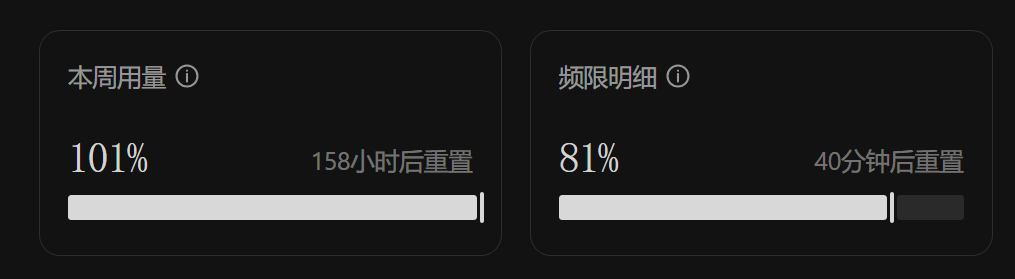
In real testing, I found a confusing issue: why does the weekly limit run out faster than the 5H quota?
This screenshot shows my usage. Less than 5 hours after the first call, weekly usage had reached 101%, while 5H usage was only 81%.
To understand what happened, I checked opencode usage statistics:
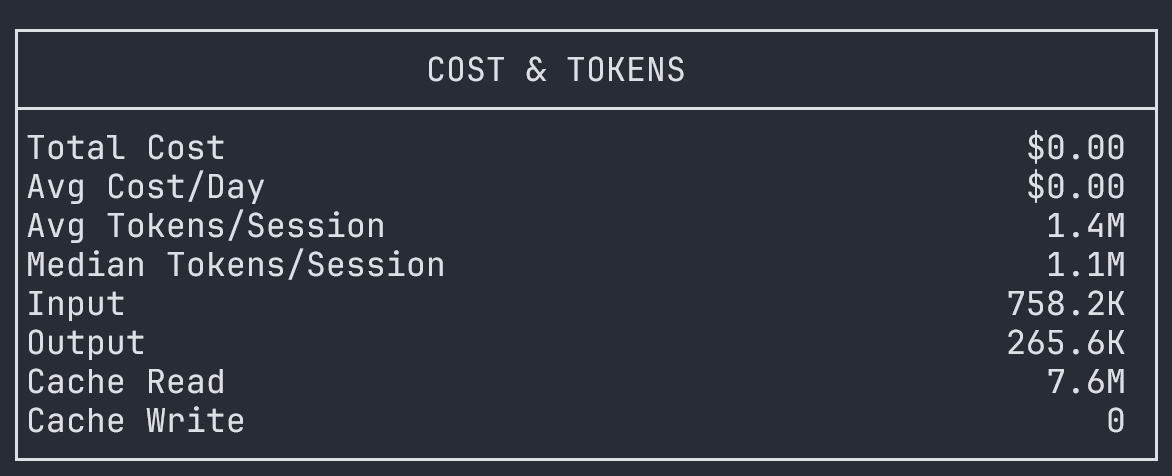
The total was about 8.6238M tokens: Input 758.2K, Output 265.6K, Cache Read 7.6M. I had previously estimated GLM Lite’s old quota at around 40M tokens, corresponding to 120 prompts in 5H. Using that baseline: $8.6238 / 40 \times 120 = 25.8714$, so I round it to 26 prompts.
Estimated Kimi weekly limits:
| Plan and price (RMB) | Quota multiple | prompts |
|---|---|---|
| Andante (49) | 1× baseline | 26 |
| Moderato (99) | 4× | 104 (26 × 4) |
| Allegretto (199) | 20× | 520 (26 × 20) |
| Allegro (699) | 60× | 1560 (26 × 60) |
Using official Kimi-k2.5 API pricing:
| Model | Billing unit | Input price (cache hit) | Input price (cache miss) | Output price | Context length |
|---|---|---|---|---|---|
| kimi-k2.5 | 1M tokens | ¥0.70 | ¥4.00 | ¥21.00 | 262,144 tokens |
Cache miss
- Usage: 758.2K = 0.7582M
- Cost: $0.7582 \times 4.00 = 3.0328$ RMB
Cache hit
- Usage: 7.6M
- Cost: $7.6 \times 0.70 = 5.32$ RMB
Output
- Usage: 265.6K = 0.2656M
- Unit price: ¥21.00 / 1M
- Cost: $0.2656 \times 21.00 = 5.5776$ RMB
Total cost: $3.0328 + 5.32 + 5.5776 = 13.9304$ RMB
If one week’s quota is worth about 14 RMB, the monthly API value is about 56 RMB. Andante costs 49 RMB, so its real value ratio is about 1.14×. Higher tiers show better value on paper.
Codex (ChatGPT): Strong Performance and Temporary Double Rate Limit#
ChatGPT’s programming offering is collectively called Codex and mainly uses models such as GPT-5.3-Codex and GPT-5.2. Pricing is relatively high, but code-generation quality and reasoning ability are strong. A temporary 2× Codex rate-limit promotion started on February 3, 2026, making the value acceptable for now.
| Price (USD) | Local 5H usage | Cloud usage (5H) | Weekly code review |
|---|---|---|---|
| Free | no official standard | no official standard | no official standard |
| Go (8) | same as Free tier | same as Free tier | |
| Plus (20) | 45–225 credits | 10–60 credits | 10–25 credits |
| Pro (200) | 300–1500 credits | 50–400 credits | 100–250 credits |
A credit is not one conversation. Roughly:
| Unit | GPT-5.3-Codex / GPT-5.2-Codex | GPT-5.1-Codex-Mini | |
|---|---|---|---|
| Local task | 1 message | about 5 credits | about 1 credit |
| Cloud task | 1 message | about 25 credits | unavailable |
| Code review | 1 pull request | about 25 credits | unavailable |
Gemini CLI and Antigravity#
Google’s quotas are relatively generous. Start with Gemini CLI.
Gemini CLI#
| Price (USD) | Per minute | Per day |
|---|---|---|
| Free | 60 requests | 1000 requests |
| Pro (20) | 120 requests | 1500 requests |
| Ultra (200) | 120 requests | 2000 requests |
Antigravity#
Official numbers are not public and limits are dynamic. The Free tier only has a weekly limit. Paid tiers use both a “5H window + weekly limit,” and the overall quota is more generous than many products at similar prices.
Gemini membership includes other benefits besides Gemini CLI and Antigravity; see the references below101112.
Claude Code#
| Price (USD) | Local 5H usage |
|---|---|
| Pro (20) | no specific standard published |
| Max 5x (100) | 5× Pro |
| Max 20x (200) | 20× Pro |
Claude Code’s weekly-limit mechanism differs by plan. Pro has one common limit for all models. Max uses a dual-track system: one shared limit for all models and one separate limit for the Sonnet model. Both reset on a rolling 7-day window after your session starts.
If a Pro user wants to call the top Opus model in Claude Code, they must manually enable and buy extra usage. The Claude account itself also includes extra web quota. For more details, see the official explanation13.
Pitfall Summary and Buying Guide#
Recommendation by Budget#
If you only want to try tools for free, Codex, Gemini CLI, and Antigravity are all good options.
Light users under 50 RMB: value is the key factor. Prefer Minimax: choose the 29 RMB Starter if budget is tight, otherwise the 49 RMB Plus. GLM Lite is worth considering only after GLM-5 becomes available and if you can avoid the 14:00–18:00 UTC+8 peak period. Kimi Andante is better only if your coding call frequency is low and you need its web benefits such as PPT, Agent, or Deep Research.
90–120 RMB: choose Minimax Max at 119 RMB if you need more usage. Choose Kimi Moderato at 99 RMB if model capability matters more.
Around 150 RMB: if you care most about native code-writing and reasoning ability, subscribe to Codex (ChatGPT) Plus at 20 USD. If you care more about quota, GLM Pro at 149 RMB offers better call volume. You can also consider the 20 USD Google AI plan for Gemini CLI and Antigravity.
151–189 RMB: use Codex + Minimax Plus or GLM Lite, ensuring one high-quality option and one high-volume option.
190–300 RMB: the only single plan in this range is Kimi Allegretto at 199 RMB. Otherwise use Codex plus one of the lower-tier plans above.
400–600 RMB: the main single-plan option is GLM Max at 469 RMB. Alternatively use Codex + Gemini + a high-quota plan.
650–900 RMB: if you care about quota, choose Minimax Ultra Fast at 899 RMB first, then Kimi Allegro at 699 RMB. If you are chasing top model capability, Claude Max 5x is more direct; if budget allows, add Codex as a second tool.
1500 RMB and above: for a single model, my capability preference is Codex (ChatGPT) > Claude Code ≈ Gemini. If using multiple tools, choose according to your own preferences and actual workflow.
Additional notes:
- GLM rules and benefits have changed frequently. The added weekly limit tightens total quota, and current speed/stability are not ideal. Heavy daily users should evaluate usage carefully and may want to wait until GLM stabilizes.
- Codex currently has a temporary quota promotion, so present value is relatively high.
- For Kimi coding plans, I recommend considering tiers above 199 RMB, especially if you truly need Kimi’s other web-side benefits.