Introduction#
This year I sent quite a few letters to friends, and it slowly became a small ritual in my life. Writing the letter, sealing it, and attaching the stamp all carry a little anticipation. I suddenly wanted to record these scattered experiences, hoping they might help you if you also want to send a letter someday.
There may be more posts like this later. I named the series “Huajian Shop”, and I hope you like it.
Stationery and Weight#
Choose whatever paper you like. Color, pattern, and thickness do not matter much. For me, two sheets are usually enough to say what I want to say. With an envelope, the total weight is about 18 grams, so it normally stays under the basic limit. If it happens to exceed 20 grams, you need to add a little more postage. If you are unsure, weigh it with a small scale first.
Some people prefer postcards: write a few simple words on one card and send it out. The form really does not matter. What matters most is what you want to say to the person receiving it.
Envelope Requirements#
Envelope rules are not as strict as before. This notice mentions that since January 2023, envelopes are no longer required to print the “supervised by the postal administration” text. So you can try beautiful envelopes you personally like.
If you are worried the envelope might be rejected, search for “mailable envelope” on shopping platforms and buy one that still has the postal-administration wording on the back. If you do not have an envelope, you can also buy one directly at the post office. It costs around 0.8 RMB.
Do not overthink the size. As long as it is not a huge irregular envelope, a common standard envelope should be fine.
Where to Buy Stamps#
Buying stamps is convenient now. For official channels, use the WeChat public account “China Post WePost Office,” enter the mini mall, or buy directly from the China Post website. The only drawback is that free shipping may require a minimum order.
There are also many discounted stamps online, but be careful of fakes. I recommend buying stamps issued in recent years and choosing stores with good reviews. Around 20% off is normal; if the discount is too steep, do not trust it. If you are still worried, buy a UV lamp and check the stamps for peace of mind.
How Is Postage Charged?#
Letters are mainly divided into ordinary mail and registered mail. Registered mail costs around three RMB more than ordinary mail, but it comes with tracking information. I usually choose registered mail. Ordinary mail feels like a message in a bottle: if it is lost, there is nowhere to look. Registered mail has a tracking number, so you can check where the letter is from time to time, and if something goes wrong you can call for help.
Postage changes with weight. The table below is for reference. You can also check prices in the “China Post WePost Office” WeChat account or on the postage page. The counter price at the post office is the final reference when mailing.
| Weight range | Local city | Other city | Example scenario |
|---|---|---|---|
| 0g - 20g | 0.80 | 1.20 | 1–3 sheets of A4 paper + envelope |
| 21g - 40g | 1.60 | 2.40 | 4–8 sheets of A4 paper |
| 41g - 60g | 2.40 | 3.60 | Thicker documents or photos |
| 61g - 80g | 3.20 | 4.80 | Small certificates |
| 81g - 100g | 4.00 | 6.00 | Near the upper limit |
| Over 100g | Charged by additional weight | Charged by additional weight | Books, materials, etc. |
How to Write the Envelope#
Domestic Chinese envelopes are usually written horizontally. Fill the recipient’s postal code in the six red boxes at the upper left. Write the full address in the blank area below, including province, city, district, street, and house number. Put the recipient’s name in the most visible middle area. Write your own address and name at the lower right. This part is important because the letter can only be returned if delivery fails. Do not forget your own postal code either. You can refer to my sample image below.
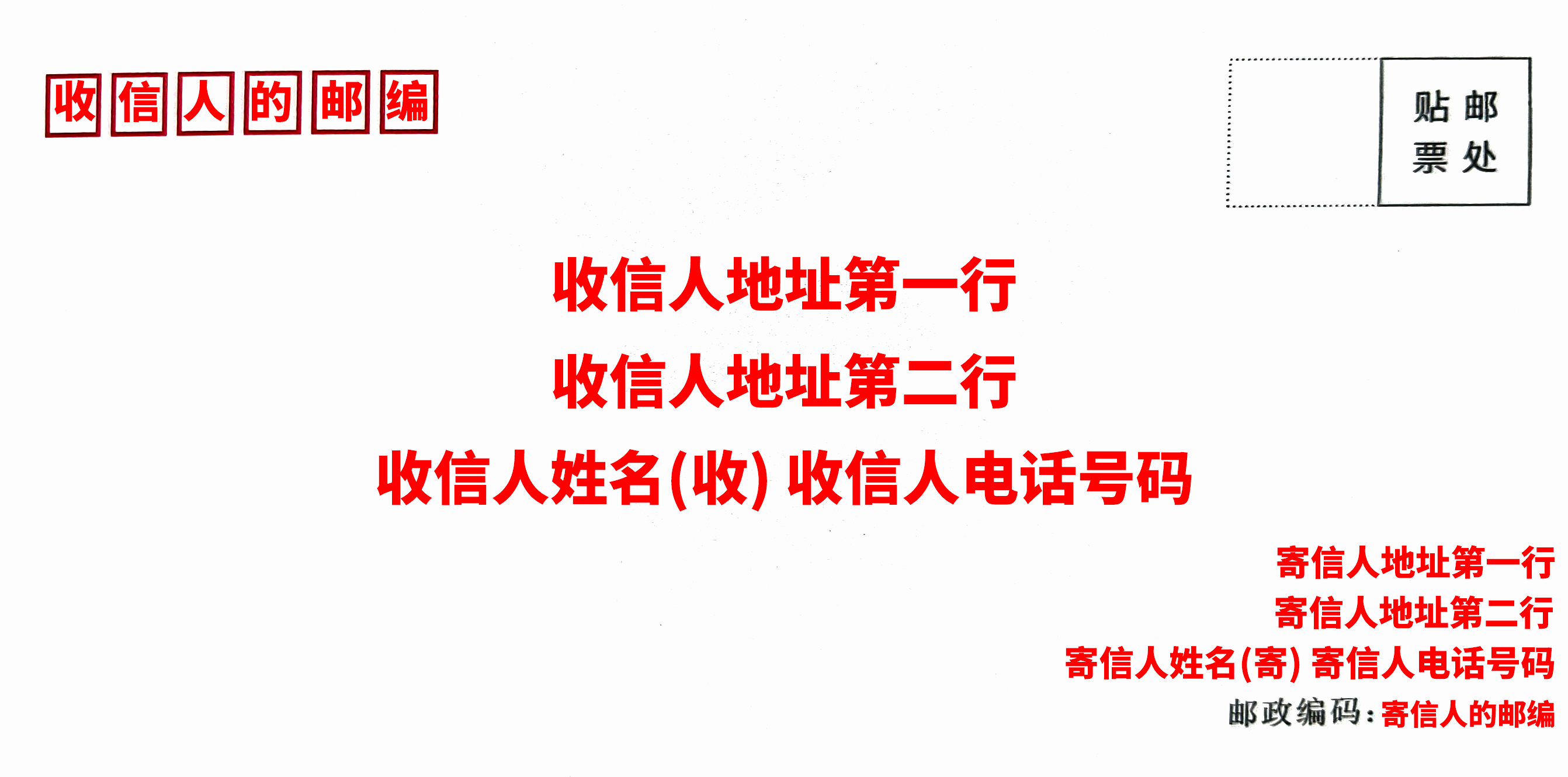
How to check a postal code: use the “China Post WePost Office” WeChat account or this postal-code lookup.
How to Attach Stamps#
Attach stamps to the upper-right corner of the front of the envelope. If you need several stamps to reach the required postage, place them neatly and avoid covering the red boxes or address information. If you are unsure, ask the counter staff. They are usually happy to help.
Where to Mail the Letter#
Ordinary mail can be dropped directly into the green mailbox outside a post office. Registered mail must be handled at the post-office counter. You can find nearby post offices through “China Post WePost Office,” or use the branch lookup page.
How Long Does It Take?#
In an age where messages arrive instantly, mailing a letter really requires patience. Within the same city, it usually arrives in two or three days, and sometimes the next day. Within the same province but across cities, it is also usually two or three days. Across provinces, the main routes are much faster now, but three to six days is common. In remote areas, especially where delivery passes through county, township, and village transfers, a letter may take ten days to half a month. It is neither very long nor very short, but waiting for a letter adds a small sense of anticipation.
One tip: when dropping a letter into a mailbox, check the “collection time” written on it and try to post before that time. It will usually be processed and sent the same day.
Registered Mail Tracking Information#
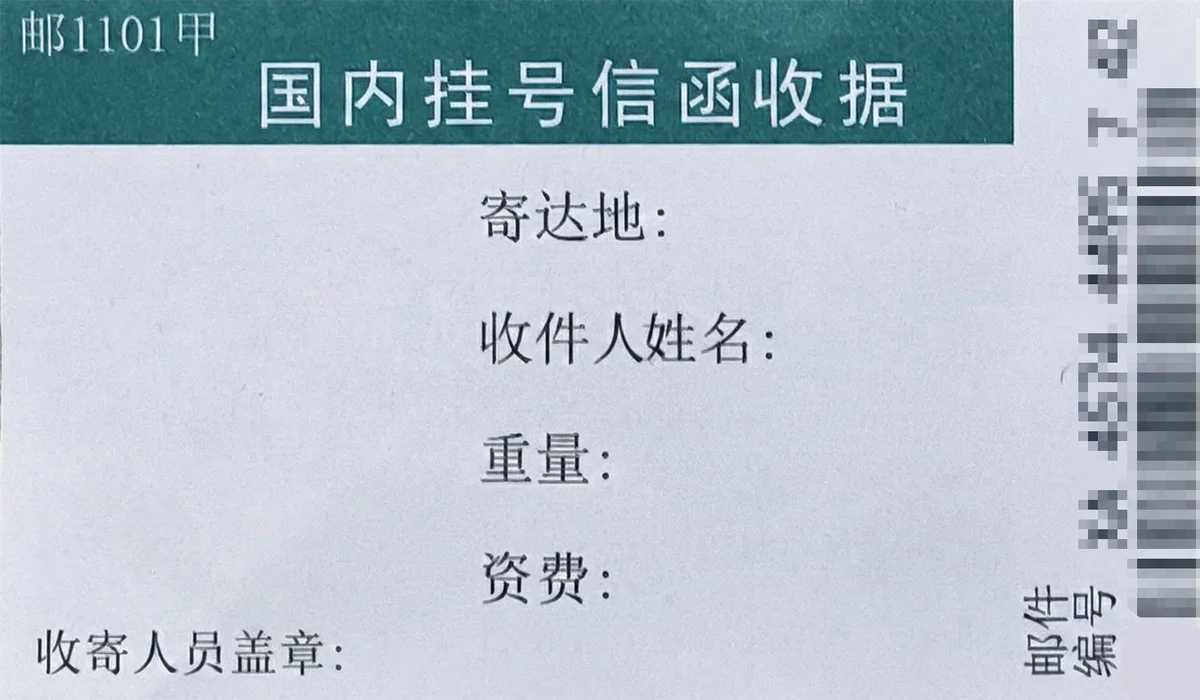
If you choose registered mail, the staff will give you a registered-letter receipt (shown below). The tracking number is written on the far right. You can check it through “China Post WePost Office” or mail tracking.
Final Notes#
Phones are faster, screens are sharper, and typing a long paragraph takes almost no effort. Sending letters seems to have become a niche obsession, but I still remember the nervousness and expectation each time I wrote a letter to a friend.
On Qixi at the end of August this year, I went to mail a letter to a friend. Behind the post-office counter sat an elderly man. He took my envelope, saw the stamp, raised his eyebrows, and asked in surprise, “Such a nice stamp, and you are using it to mail a letter? Doesn’t that feel like a waste?” To people of his generation, these stamps might be collectible treasures that appreciate in value.
He carefully checked whether there were prohibited items inside, but he very tactfully avoided looking at the content of the letter. After a glance, he said, “Your handwriting is quite good.”
There were not many people handling business at noon that day. A few staff nearby heard him and came over to chat. They sighed that very few people send letters now and also praised the neat handwriting. That moment felt warm.
I believe the person receiving a letter feels just as happy as the person sending it.
Only when you truly pick up a pen, wait for the ink to dry, and place the letter into a mailbox can you feel what it means for travel, horses, and mail to all be slow.
The phrase “seeing your words is like meeting you” is no longer just four dry characters. Waiting for the other person to receive the letter, and waiting for that simple “I got it,” makes the feeling more concrete. A letter comes from afar, crosses cities and villages, passes mountains and seas, and finally lands in your hands, as if I had walked up to you in person.
Sometimes only a letter can send out emotions and longing that are hard to explain. As the song Love Letter says, “Only letter paper can fully express my love.”
I hope you also try sending a letter and feel the weight of that affection.
If you like this style, I will continue writing small experiences like this in “Huajian Shop.” You are also welcome to leave a comment and chat.