Overview#
Bohrium Research Space Station is reshaping academic search. It combines Deep Thinking (R1) and a research-oriented ChatGPT-4o engine with CARSI authentication and a photon billing system, giving researchers natural-language dialogue and multimodal search across text, charts, PDFs, and molecular structures.
The platform covers about 160 million papers, 160 million patents, and 20 million scholar profiles. With intelligent ranking and recommendations, it can capture emerging research topics quickly. Peking University also launched the “Science Navigation” AI research platform campus-wide in May 2025, which shows the practical momentum behind this type of research platform.
AI search modes#
| Mode | Core model | Main advantage | Photon cost |
|---|---|---|---|
| Deep Thinking (R1) | DeepSeek-R1 reasoning model | Open MIT license, convenient for secondary development and local deployment | Free |
| ChatGPT-4o | OpenAI GPT-4o research-customized model | Strong multilingual and cross-disciplinary knowledge, good for reviews and ideation | 30 photons / query |
Author note: R1’s chain-style reasoning and long-context behavior fit my habits better, while 4o remains strong for multilingual polishing and creative writing.
Bohrium versus Google Scholar#
| Feature | Bohrium AI Search | Google Scholar |
|---|---|---|
| Literature coverage | Papers plus patents at the 160-million scale, incremental crawling, and scholar profiles | Broad coverage, but updates depend on publishers |
| Retrieval method | Natural language, intent recognition, and multimodal input | Keywords and Boolean operators |
| Result presentation | Summaries, charts, actionable steps, batch Q&A, and model switching | Titles, abstracts, citation counts |
| Traceability | AI answers include source anchors | Quality varies, including preprints and non-peer-reviewed items |
| Accessibility | Direct full-text links after registration and CARSI access for Chinese universities | Many papers require proxy or mirrors |
Example workflows#
For a quick overview of recent smart-factory progress, choose Deep Thinking (R1) and ask: “Summarize the main smart-factory breakthroughs since 2024 and list the key papers.” Within a short time, Bohrium can return a structured summary, charts, citations, and links to originals.
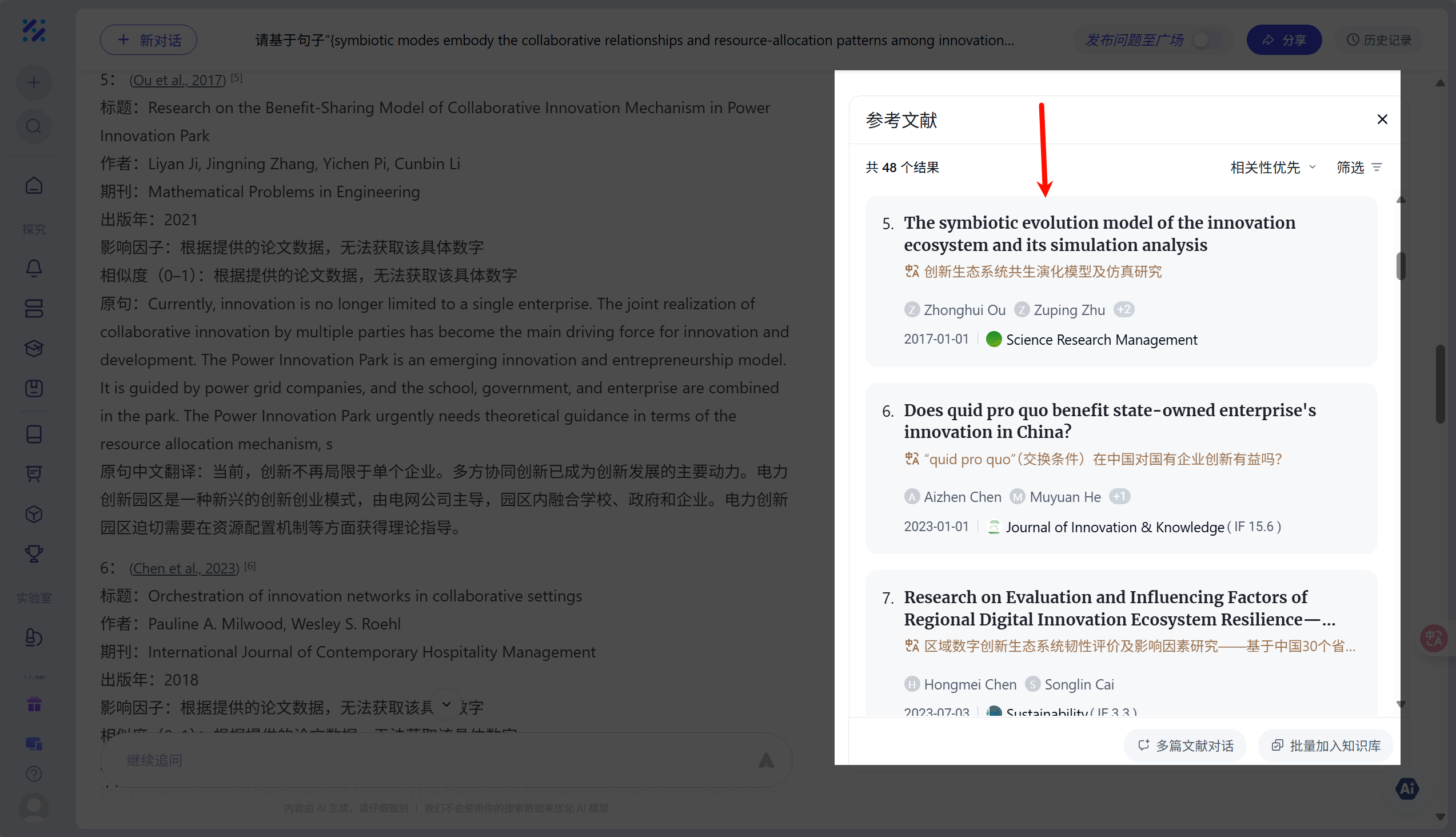
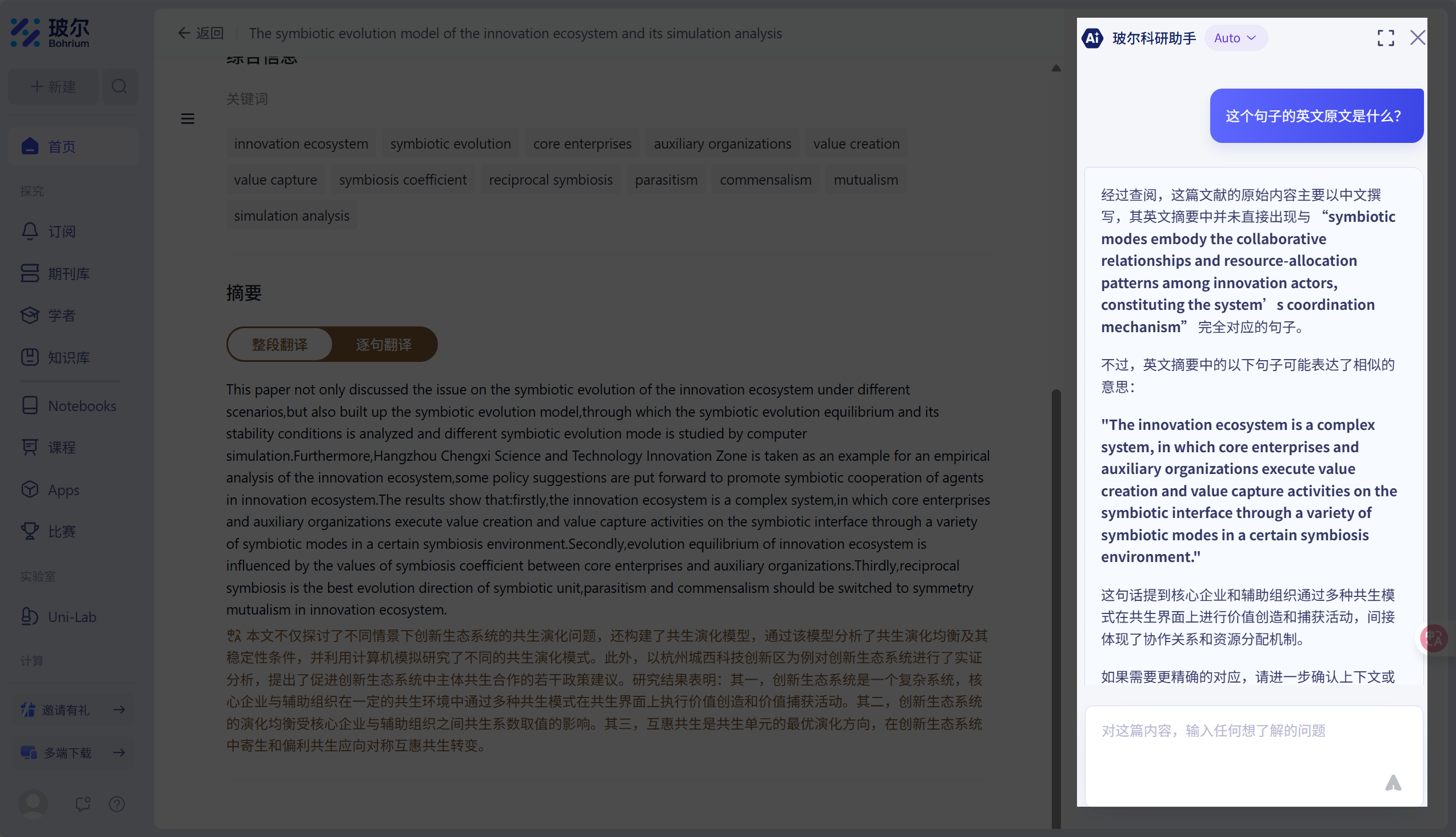
For more targeted reference retrieval, ask Bohrium to search abstracts and introductions for sentences conceptually closest to your argument sentence, rank the top 10 papers by semantic similarity, and return titles, authors, journals, year, impact factor, citations, matched sentences, and bilingual translations. If the returned sentence looks like a summary rather than a direct quote, open the paper detail page and ask the built-in AI whether the article contains a passage with the same meaning.
Photon resources#
- Daily check-in: CARSI login can grant 300 photons/day.
- Invite friends: both users receive 1000 photons.
- Competitions and events: AI4S Cup and research challenges provide additional photons.
- Mutual 1000-photon link
Subscriptions, knowledge bases, notebooks, courses, and apps#
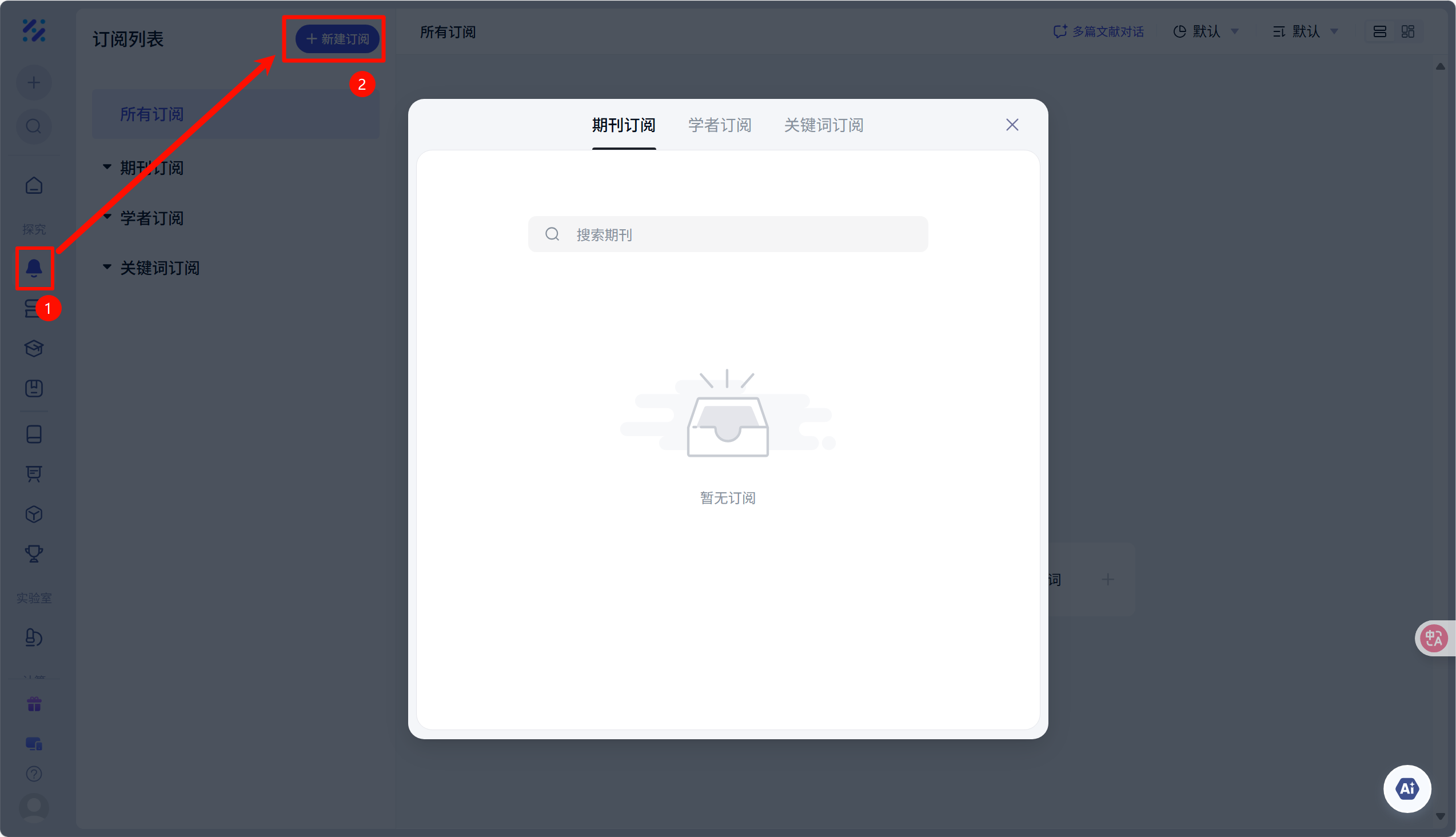
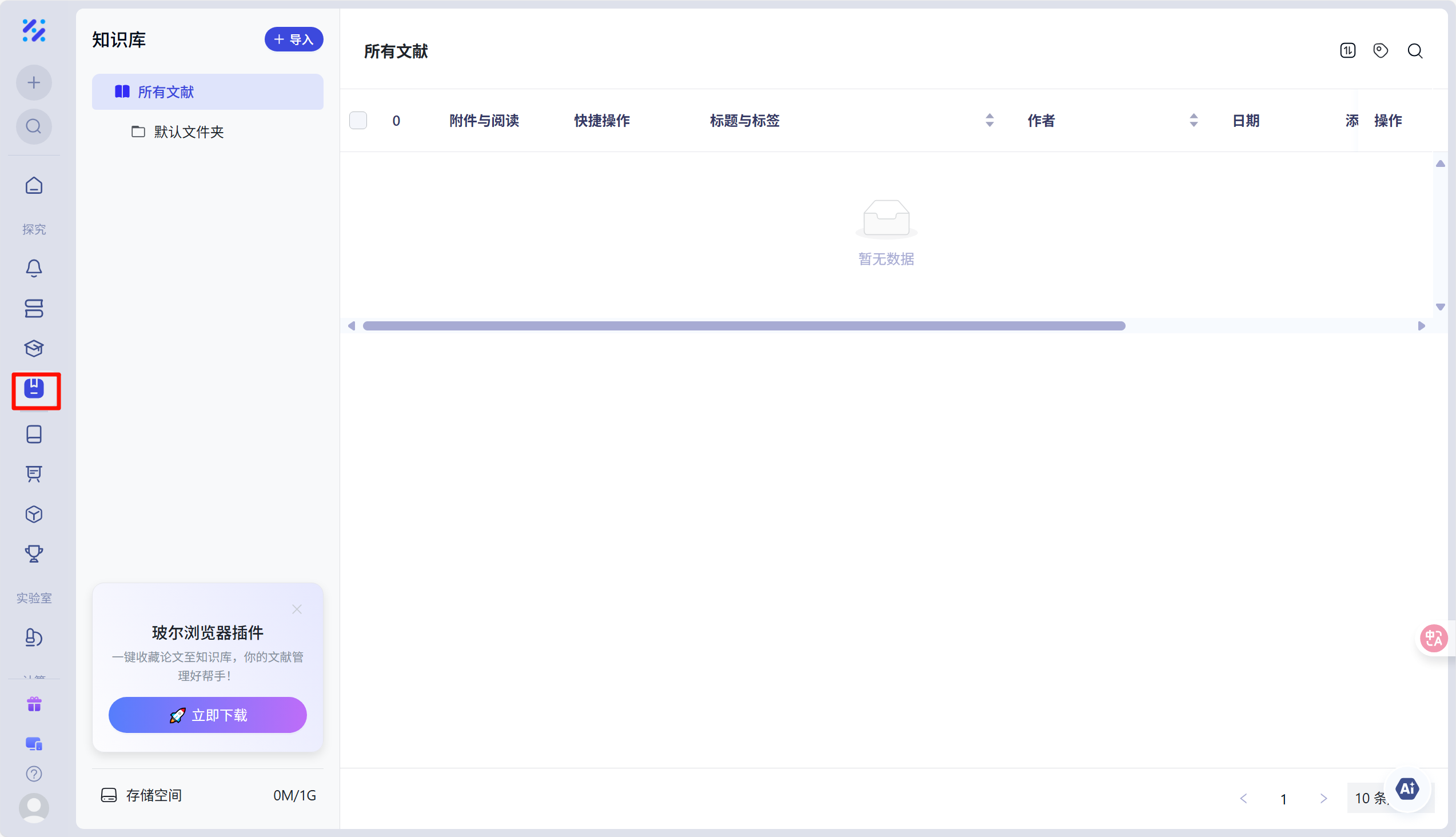
Bohrium can subscribe to journals, keywords, or scholars and push updates when new work appears. Its research-asset management combines papers, patents, notes, tags, and batch AI Q&A. The Knowledge Base supports Markdown, LaTeX, Python, R, and Matlab interactive execution; AI assistants can explain and rewrite code; and Bohrium HPC resources support cloud-based reproduction of molecular dynamics or quantum-chemistry experiments.
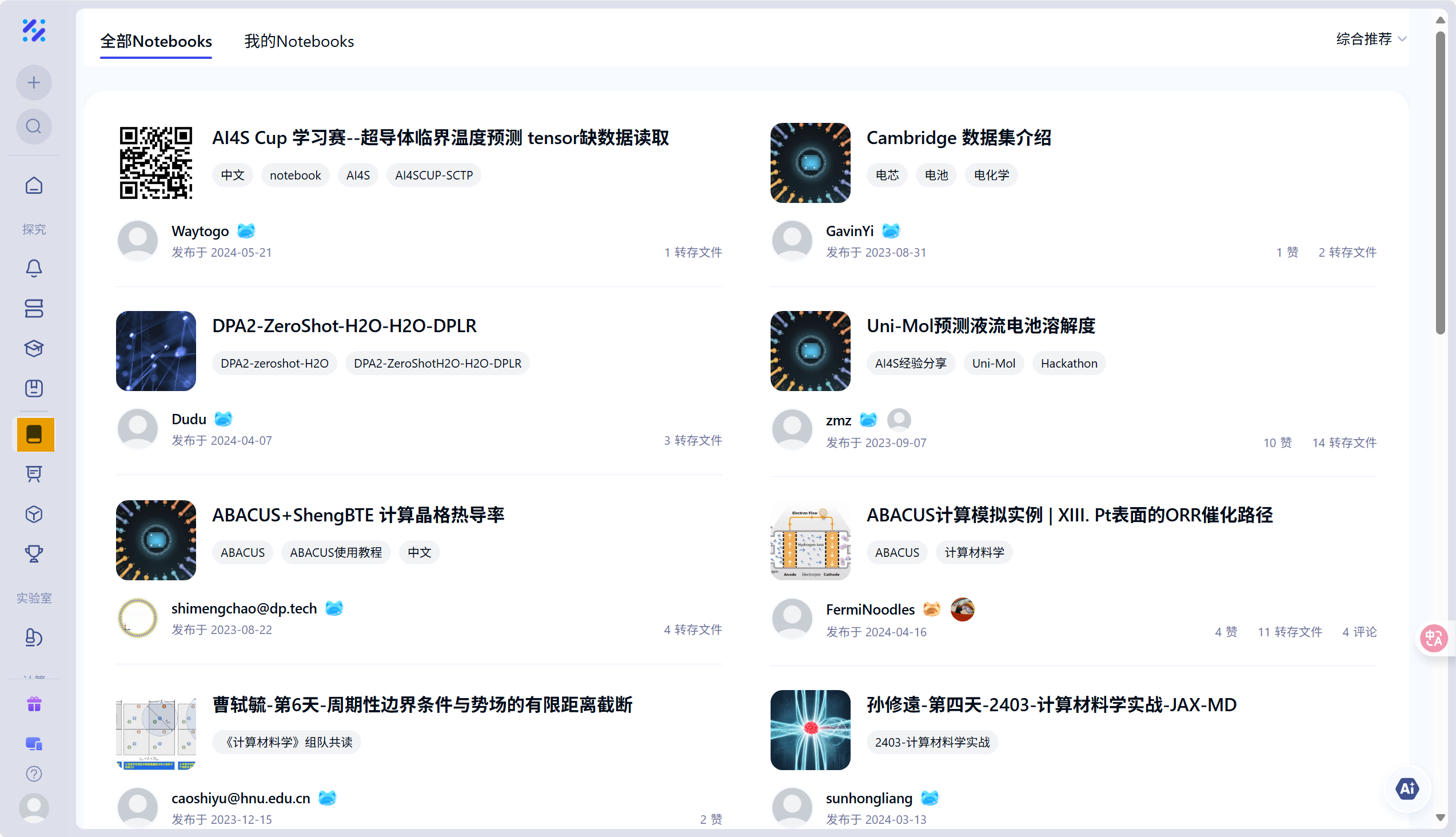
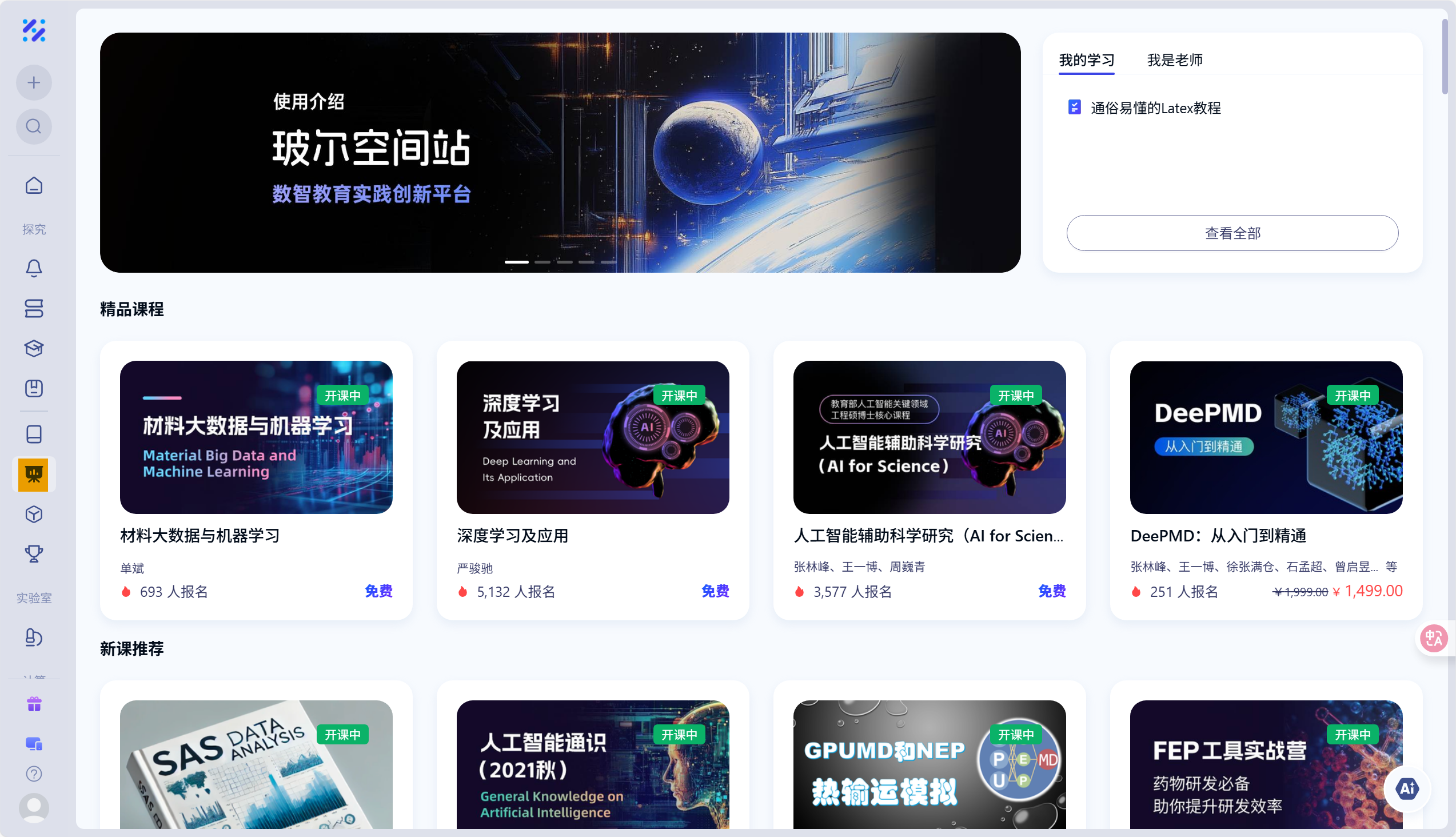
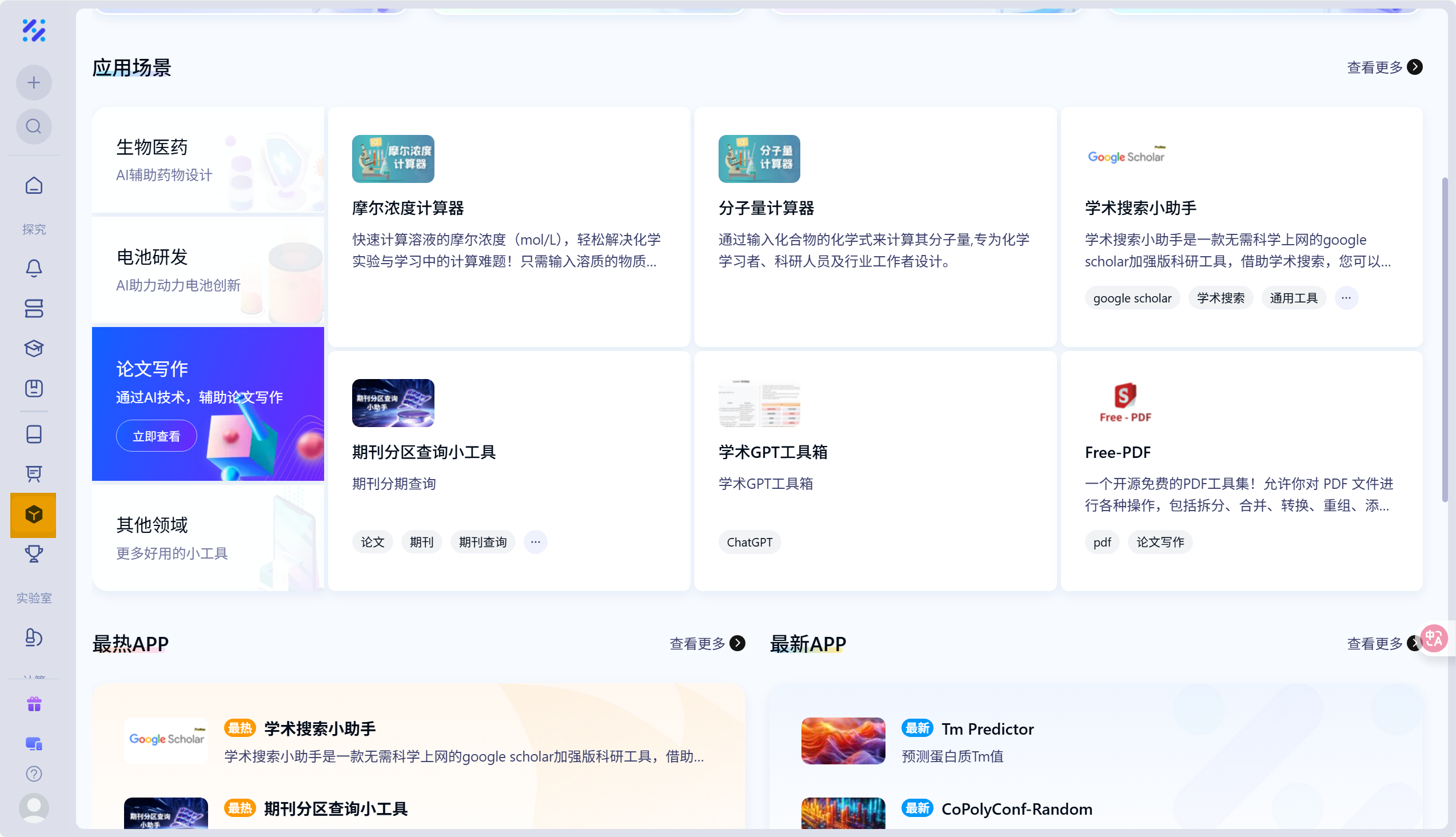
Notebooks share the same runtime environment, support public or private team publication, and include version control and diff views. The ecosystem also includes more than 60 free courses and over 200 research apps covering paper search, journal ranking, molarity calculation, experimental design, and more.
Summary#
- Bohrium = search + workflow: AI retrieval, knowledge base, notebooks, apps, and HPC in one platform.
- Complementary models: DeepSeek-R1 is strong at reasoning and long context; GPT-4o is strong at multilingual and creative work.
- Better retrieval experience: natural-language and multimodal input produce actionable and source-linked answers.
- Flexible photon system: check-ins, invites, and events provide credits; R1 is free and 4o is higher-performance.
- Rich ecosystem: subscriptions, asset management, courses, and apps cover much more than basic literature search.
Screenshots and media#
Preserved command, configuration, and prompt blocks#
| |